Winsor McCay
American
Ca. 1922
Pen and black ink over graphite on paperboard
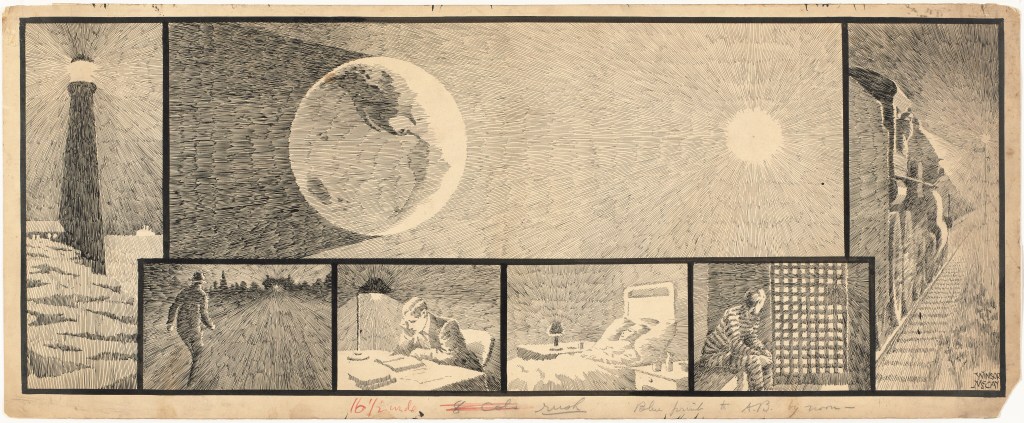
I won’t lie and say that I wasn’t only looking for a painting when searching for art today. I think sometimes I get stuck on all of the famous painters and find myself looking at their works, and I forget that art can be quite literally anything. Now, prints are very “painting adjacent” in my opinion, but again, I was looking for a painting. Maybe that’s why I came to a complete halt when I stumbled upon “The Lamps of God” by Winsor McCay. Not only is the content compelling (I’ll get to that soon), but the composition and craftsmanship of this piece are incredible. Take a second to zoom in here and look at just how many lines are creating each section. Maybe this pulls on my impressionism-lover heartstrings a little, but I am absolutely infatuated with this piece.

Before I get into this, I want to add that I was raised Catholic, so that deeply impacts how I view this piece. I can admit that I am not thoroughly educated on the detailed teachings of other religions, so for this discussion, I will only be analyzing this print with my own personal experiences with Catholicism and the Bible.

The title gives us a lot of context here, but I still think there is some inferring left to the observer. Naturally, the top middle section caught my eye, and I’m assuming that was very intentional. The Sun shining on the Earth would most definitely be considered a “lamp of God,” if not the “lamp of God,” seeing as life itself would not exist without it. But it is the other sections of this piece that are what really made an impact on me.

Starting on the left, we see the lighthouse. Lighthouses are guiding lights to those at sea, letting them know that they have reached their destination. But it is also important to recognize that lighthouses also are warnings to boats so they do not wreck in shallow waters. Serving as signals of both home and heedance, it’s easy to see how God fits into the narrative here. Even more simply recognized, God is seen as a guiding light in every monotheistic religion.

I’m going to skip to the next largest section of this piece on the right, which (after a lot of staring) is what I believe to be a train travelling away from us. I found it interesting that the focus here is not the train’s headlight, but the lamppost to the right (at least that’s what it looks like to me). I would have originally expected the train’s headlight as it could represent innovation, travel, or movement, but based on my analysis of the lighthouse I think the lamppost makes complete sense. It is illuminating the path for the train, and in knowing the title of this print, it made me think of Psalm 18:28: “The Lord, my God, lights up my darkness.” If I dig into that a little more, the light the lamppost provides could be a reference to the comfort God provides to His followers.

Moving down to the bottom four sections, I will be completely honest and say that I still am not 100% sure what the first one is. My initial guess was a man running towards the tree line with the sun shining through the trees, but I don’t know if the details are necessary anyway. I think the whole point here is that the man is moving towards the light source, once again symbolizing God a guiding light. The second section is a man reading with a lamp to illuminate his space. This is the first time in this piece that we see the light source as an actual lamp. In recalling the name of the print, “The Lamps of God,” I want to think that there is a deeper meaning in this one. I’m drawn back to the imagery of God illuminating the paths of His followers and could see that applying here as well. The third appears to be an elderly person lying in bed with a cup and bottle on one side and a lamp on the other. I immediately thought back to the Bible verse I mentioned earlier, Psalm 18:28. I think the light from the lamp here is symbolizing the comfort God brings to many, especially in moments of poor health or even death. The fourth and final section of this piece is an inmate looking out at the light coming through the door of his cell. My initial reaction was to see the light in this image as a reference to freedom and liberation. Taking that a step further with the themes of God in this print, this light could be symbolizing how one is not liberated until they know God. This could also lean into the idea of being unburdened of sin.

Overall, I think McCay did an incredible job with lacing the theme of God as a source of comfort and direction into this print. It didn’t take me long to find this in almost every section, even though they all cover vastly different scenarios. Life is complicated and difficult, so it’s easy to see how finding God in something as simple as a lamp can ease the mind. Even if I read far too deep into this piece, I really enjoyed it. Like I said at the beginning, besides the content, the talent and patience it takes to create something like “The Lamps of God” is a marvel in itself. I’m so glad this one found me, and I’m hoping I’ll stray away from paintings more often in the future.
Image sourced from the National Gallery of Art
 Not an Artist